It's not usually the first decision people make when planning a spiral staircase — but it should be. Here's what to consider.
What feels natural
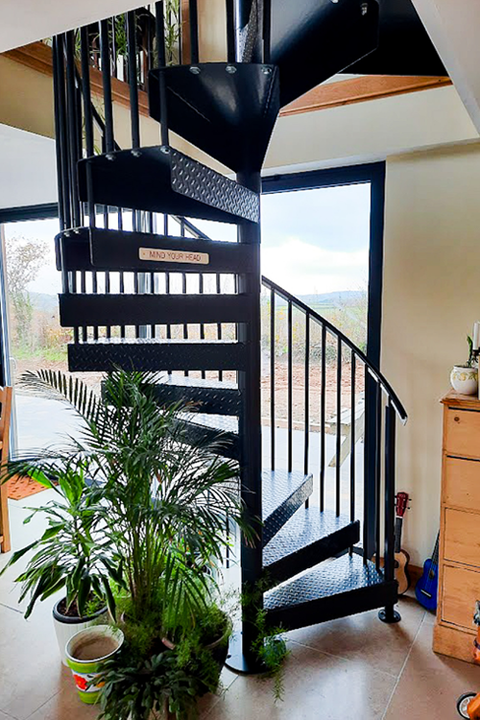
Around 75% of spiral staircases ascend anti-clockwise, with the right hand on the handrail going up. This is thought to reflect the fact that most people are right-handed, making it the more instinctive choice. Interestingly, there's some evidence that the preference reverses in the southern hemisphere — though whether that's down to the rotation of the earth or simply cultural habit isn't entirely clear. The point is, what feels natural to one person may not to another, so it's always worth thinking about before you order.
Position within the property
Where the staircase sits — and which way it turns — has a big impact on how well it flows with the space around it. You should never enter or exit a staircase facing a wall, and the direction of travel plays a key role in achieving a logical, comfortable route through the building. Most spiral staircase kits rotate between three-quarters and one full revolution, so this decision deserves careful thought.
Headroom
This is the factor most often overlooked. Building Regulations require a minimum of 2,000mm clear above the pitch line (the front edge of each step), and you'll also need adequate headroom when walking under or around the staircase. Switching direction — clockwise to anti-clockwise or vice versa — can sometimes resolve a headroom problem that seemed unavoidable, which is why 3D modelling is such a useful tool at the planning stage.
Not sure which way to go?
Take a look at our spiral staircase kits or get in touch with the team — we're happy to help you work out what's right for your space.